
The set account was the usual answer to the question of where to place funds for many years. It seemed safe, reliable, and simple to understand. You know what comes out when you spend money. However, a separate worry is getting support as more investors begin to prepare for goals that are ten, fifteen, or twenty years away: is reliable the same as sufficient?
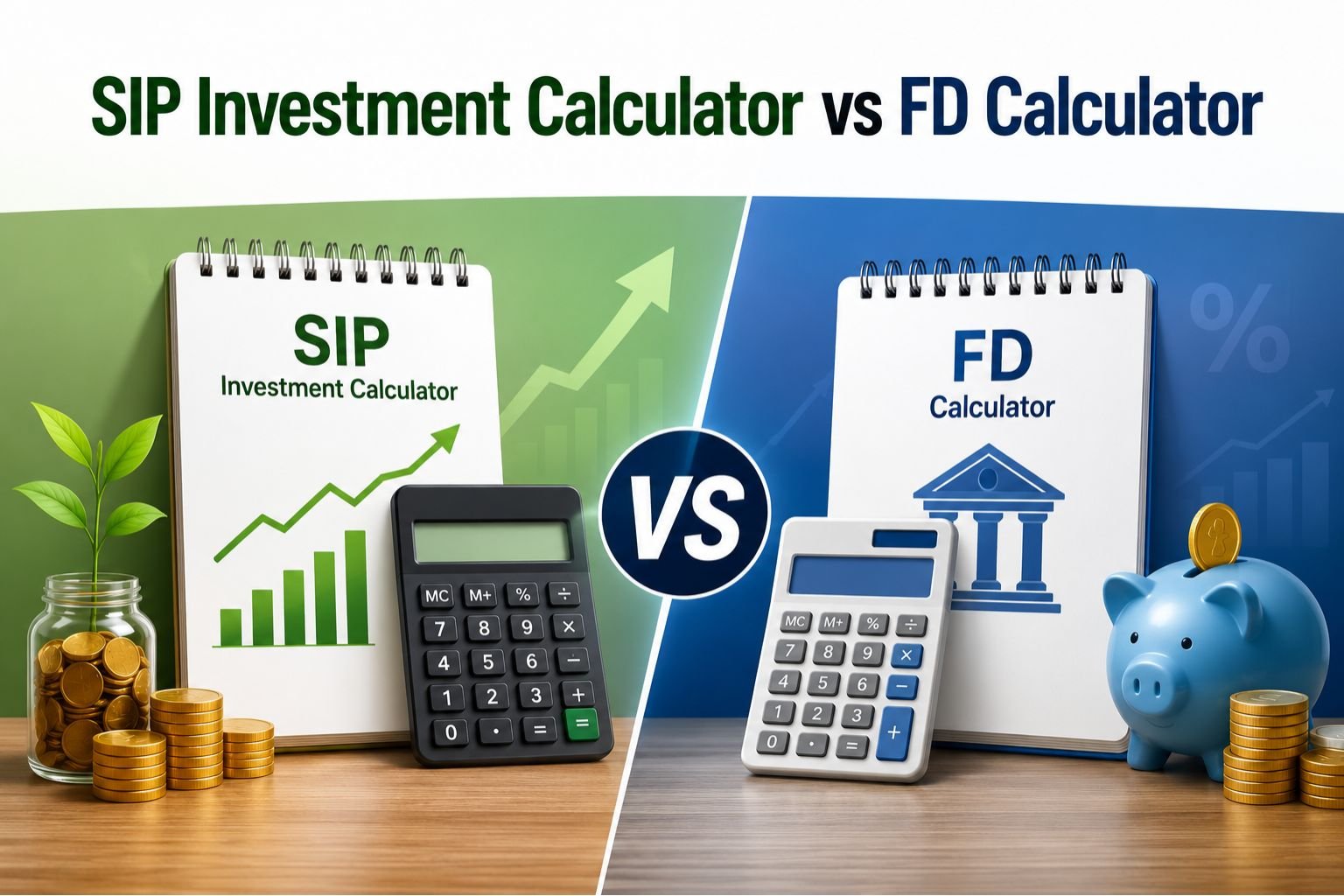
One of the easiest ways to answer to that question with facts rather than opinion is to compare an FD calculator with a SIP investment calculator.
What Each Calculator Is Actually Measuring
Depending on the payment system of the bank, an FD calculator works on either basic or compound interest. The tool gives the final value once the investor adds the capital amount, term, and interest rate, which is usually between 6.5 and 7.5 percent for the majority of Indian banks nowadays. The math is clean and the outcome is fixed from day one.
A SIP investment calculator works differently. Instead of a lump sum, it maps out what happens when a fixed amount is invested every month over time, with returns compounding on the accumulated corpus. The inputs are monthly contribution, expected annual return, and investment duration. What comes out is a projected maturity amount that accounts for the snowballing effect of returns building on returns.
Where the Gap Starts to Show
The real difference between the two tools becomes visible over long tenures. When you run both tools for the same monthly commitment over a 15-year time, it is hard to miss the difference in the expected results.
Over a 15-year time, a monthly FD of Rs 10,000 at 7% gives a sum of between Rs 31 and Rs 32 lakh. The same Rs 10,000 per month in a SIP investment calculator at 12 percent annual returns over 15 years projects somewhere around Rs 50 lakh. That is not a small difference. It reflects the structural advantage of equity-linked compounding over fixed-rate interest.
The Role of Risk in the Comparison
This is the part where the FD argument is strongest. An FD calculator gives guaranteed numbers. A SIP investment calculator gives projections based on an assumed rate of return, and equity markets do not move in straight lines. Returns vary year to year, and some years are negative.
But this is also why long tenure matters. Over 15 to 20 years, short-term volatility in equity mutual funds tends to average out, and the historical return data for diversified equity funds supports the assumptions that most SIP calculators use as benchmarks.
Using Angel One to Run Both Scenarios
Angel One provides a SIP investment calculator that is free, accessible without logging in, and built for exactly this kind of side-by-side thinking. Investors who want to compare their current FD strategy against a potential SIP plan can run the numbers on the same screen and make a side-by-side judgment based on their own risk appetite and timeline.
Pairing that with a reliable FD calculator gives a full picture. Neither tool makes the decision. Together, they make sure the decision is made with clear eyes.
