
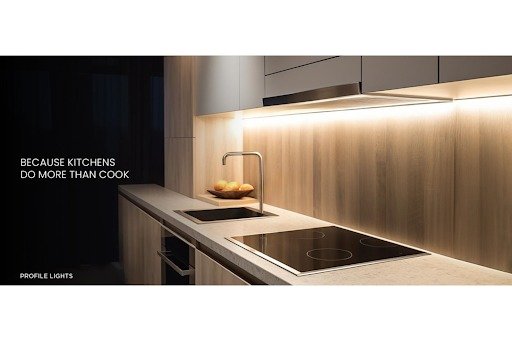
The kitchen serves as the home’s functional core, supporting daily cooking, storage, and social interaction. From early-morning routines to late-night cooking, lighting must support visibility, safety, and comfort throughout the day. Unlike living rooms or bedrooms, kitchen lighting must be functional first, without compromising on visual appeal. This is where well-planned indoor lighting plays a crucial role.
With the growing shift towards LED technology, homeowners now have access to energy-efficient, long-lasting, and versatile lighting solutions. However, choosing the right LED lighting for your kitchen is not just about selecting bright lights. It involves understanding how different lighting layers work together, where specific fixtures should be placed, and which technical features matter the most.
Understand the Lighting Needs of a Kitchen
A kitchen typically has three key lighting requirements:
- General illumination
- Task lighting, and
- Accent lighting.
Each serves a different purpose and must be planned accordingly.
General lighting provides overall brightness and ensures the space is well lit. This is usually achieved through ceiling-mounted fixtures such as LED panel ceiling lights, which distribute light evenly across the room. Task lighting focuses on specific work areas like countertops, sinks, and cooking zones, where clear visibility is essential. Accent lighting highlights architectural elements or design features and adds depth to the space.
A well-balanced kitchen lighting plan uses all three layers to create a functional and visually comfortable environment.
What are LED Lights and Why are they Ideal for Kitchens?
LED stands for Light Emitting Diode. Unlike traditional bulbs that rely on heating filaments, LED lights produce illumination through semiconductor technology. This makes them significantly more energy-efficient and longer-lasting.
LED lighting is ideal for kitchens for several practical reasons. First, LEDs consume much less power while delivering high brightness, making them cost-effective for daily use. Second, they produce very little heat, which is important in a space already exposed to cooking temperatures. Third, LEDs offer instant full brightness without warm-up time, which is useful when quick visibility is required.
From a performance perspective, LED systems provide consistent light output, better colour accuracy, and longer operational life. Most LED fixtures are designed for long operational life, often delivering consistent performance for several years without requiring frequent replacement. These features make LED the most suitable choice for modern kitchen indoor lighting.
Types of LED Lighting for Kitchen and Where to Use Them
A well-lit kitchen uses multiple lighting layers to ensure proper visibility across all functional areas. Different LED fixtures serve different purposes.
LED Panel Ceiling Lights
LED panel ceiling lights are commonly used as the main source of lighting in kitchens. They provide uniform illumination across the entire space, ensuring there are no dark corners or uneven brightness.
These lights are usually installed on the ceiling and are ideal for general lighting. They work well in both small and large kitchens, especially in modular layouts where consistent brightness is required. LED panels also offer high lumen output with low energy consumption, making them suitable for everyday use.
LED Strip Lights
LED strip lights are primarily used for task lighting. They are installed under wall cabinets, inside shelves, or along countertops to provide focused illumination on working surfaces.
These lights help eliminate shadows created by overhead lighting and improve visibility during food preparation. LED strip lights are flexible and can be customised in length, making them ideal for compact kitchens and storage areas. They also enhance safety by clearly illuminating cutting and cooking zones.
Profile Light
A profile light is a linear LED fixture designed for seamless integration into kitchen structures such as cabinets, shelves, or ceiling grooves. These lights offer a clean and modern look while delivering consistent illumination.
Profile lights are widely used in contemporary kitchens for both task and accent lighting. They provide glare-free output and maintain visual continuity across the space. Due to their slim design, profile lights are ideal for modern layouts where minimal fixtures and integrated lighting are preferred.
LED Pendant and Accent Lighting
Pendant LED lights are often used above kitchen islands or breakfast counters. They provide focused lighting and also contribute to the visual layout of the space. Accent lighting, on the other hand, highlights design elements such as open shelves, display cabinets, or textured walls.
These lights are not essential for functionality but help improve spatial depth and overall ambience.
How to Choose the Right LED Light for the Kitchen?
Selecting the right LED lighting involves more than choosing fixtures. Several technical factors must be considered to ensure performance and efficiency.
Brightness and Lumens
Lumens measure light output. Kitchens require higher brightness compared to bedrooms or living areas. General kitchen lighting usually needs between 300 to 500 lumens per square metre. Task areas may require higher lumens for clear visibility.
Colour Temperature
Colour temperature affects how light appears. Neutral white (around 4000K) is ideal for kitchens as it provides balanced brightness without being harsh. Warm white may reduce visibility, while cool white can feel too clinical for residential spaces.
CRI (Colour Rendering Index)
CRI indicates how accurately colours appear under lighting. A CRI above 80 is recommended for kitchens to ensure food colours and surfaces look natural and clear.
Energy Efficiency and Wattage
LED lights consume less power, but wattage still matters. Higher lumens with lower wattage indicate better efficiency. This helps reduce electricity consumption without compromising brightness.
IP Rating for Safety
For areas near sinks or cooking zones, LED fixtures with higher IP ratings are recommended. This ensures protection against moisture, dust, and heat exposure.
Layout and Placement
Lighting should be positioned to avoid shadows on work surfaces. Under-cabinet lighting using LED strip lights and integrated profile lighting helps achieve balanced visibility across all zones.
Final Thoughts
Choosing the right LED lighting for your kitchen improves functionality, safety, and long-term efficiency. From LED panel ceiling lights for general brightness to LED strip lights for task areas and profile light systems for integrated illumination, each lighting type plays a specific role.
Jaquar is one such reliable brand that offers lighting solutions combining technical performance with modern design standards. Their profile lights are engineered for uniform output, low energy consumption, and long operational life, making them ideal for contemporary kitchen environments.
If you are planning to upgrade your kitchen lighting, explore Jaquar’s profile lighting range to achieve a balanced combination of efficiency, visibility, and modern aesthetics. The right lighting not only improves daily functionality but also adds lasting value to your space.
